Crystallized Ginger Recipe


Homemade beauties.

I’ve always loved using crystallized ginger but for some reason avoid buying it at the store. It’s ridiculously expensive so I don’t end up using it as much as I want to in my baking. When I was in Peru I really wanted to have some, but it was unavailable. People didn’t even know what it was. A sweet storekeeper was interested in what I was going to do with it, so she gave me a bunch of ginger for free and I promised to bring her back some crystallized ginger. I only saw it grated into soups while I was there, so I felt like a messenger, bringing the good news of kion confitado. Sadly, Maria didn’t like it but I had to hide it from the 3 year old grandson of the family we were staying at. He was addicted to it and it came out so intense that I couldn’t eat it just plain. He, on the other hand, could eat a fistful.


Ginger Root.

It is easy to make and if you have the time, I suggest you give it a try. You don’t need any fancy equipment, just a pan and sugar and something to dry it on (I used cookie cooling racks). You might want to also know that ginger is good for digestion, helps with colds and sore throats, and it’s been linked to lowering cholesterol and relieving arthritis pain. And it tastes great so get to it! I like to put crystallized ginger in muffins.

Crystallized Ginger
Yield: As much as you want (this should yield 3/4 cup)

Ingredients

  • ginger root, peeled and sliced as thin as you can (1/2 cup)
  • 1.5 cup water
  • 1.5 cup sugar (you can use more or less, just keep the ratio equal)
  • extra sugar for coating (1/2 cup should be fine)

The process.

Method

  1. Peel and slice ginger. Set aside.
  2. Bring sugar and water to a boil in a small saucepan.
  3. Add ginger slices and reduce heat to a simmer.
  4. Simmer 30-45 minutes, or until the ginger is tender (bite it! but don’t burn yourself).
  5. Drain ginger on a rack of sorts for 15-20 minutes.
  6. Put the sugar in a shallow bowl and toss ginger slices in sugar, coating thoroughly.
  7. Dry on rack or wax paper.
  8. Once dry and hardened (a few hours or overnight), store in an airtight container indefinitely.

Sugar coating makes everything better

Bonus Recipe
Ginger Syrup

(Put on your pancakes, waffles, ice cream, in your tea, wherever)

  1. With your leftover sugar water in the saucepan, continue to simmer until it become syrupy, but not as thick as honey.
  2. Store in an airtight container in the refrigerator for…I’m not sure. It’s never gone bad on me.

Note: If the syrup crystallizes in the fridge just heat up and add some more water to it.

Popularity: 3% [?]

Homemade Pumpkinseed Milk in a Hurry


Drink up!

We’ve been reducing our soy consumption for a number of reasons, mainly because soy is known to aggravate hypothyroidism and I want our protein to come from a variety of sources. One of the ways I have done this is to replace my soymilk with nut and seed milks. I have detailed Cashew Milk making in the past, today we’ll discuss milk made from pumpkin seeds.

I love cashew milk, but the nuts are expensive. Pumpkin seeds were on sale at my co-op last week for $2.49 a pound (the cashews are $8 a pound and the almonds are $14!) I stocked up on pumpkin seeds and we are now enjoying a new kind of creamy milk. It’s not as neutral as cashew milk, but I don’t think it’s earthy like hemp milk is. It’s perfect with granola, in smoothies and in baking. And a glass of warm pumpkin seed milk with some cinnamon is really nice before bed (or iced, during the day). The nice thing about pumpkin seeds is not only are they a source of protein, good fat and lots of minerals, but it lowers cholesterol levels, promotes healthy bones (unlike cow’s milk) and helps with depression and learning disorders. It even helps with arthritis, so make an extra batch for grandma!

It takes less than 5 minutes to whip up a batch of milk, so you can make it whenever you need it. I typically make a quart at a time. It starts to go bad between 5 and 7 days (you can smell it), so only make as much as you need. Here’s my simple easy recipe to get you ready to save some money and take care of your body with the power of pumpkins.

Pumpkin Seed Milk    Yield: 1 quart


Ready to blend

Ingredients

  • 1/2 cup raw pumpkin seeds (you can soak them overnight and drain before using, or use them as is if you don’t have time)
  • 1 Tablespoon ground flax seed
  • about 3 cups hot water (or 1 cup hot and the rest lukewarm is fine)
  • 1 Tablespoon sweetener of choice (or more if you want)
  • 1 teaspoon vanilla extract

Ready for liquids

Method

  1. Drain and rinse seeds if they were soaking.  (Soaking them releases enzyme inhibitors and makes them easier to digest all that good stuff.  I’ve made this milk with soaked and unsoaked seeds and both versions come out awesome.  If you don’t soak, use all hot water to help break it down.)
  2. In a blender (NOT a food processor, it comes out really grainy and you have to strain it) place the seeds and flax and pulse until your mixture is the consistency of sand (coarse is fine).
  3. Add about a half cup of hot water and blend your sludge well.
  4. With the machine running, add 2 cups of water, vanilla and the sweetener.
  5. Stop the blender and pour a shot of milk and taste it.  If it’s bitter, add a little more sweet or vanilla.  If it’s too thick for you, add more water.
  6. Store in a glass container in your fridge for up to a week.  Shake well before using and enjoy!

Popularity: 16% [?]

Sausage-fest


Kraut Dog

Vital wheat gluten is a wonderful thing. My first encounters with seitan (the wheat meat) were unflavored store-bought varieties over 10 years ago. This little gluten has come a long way from Chinese Buddhists of the past. While in culinary school I wanted to learn how to make it, the traditional way. One of my chef instructors knew how but laughed at me. I always wanted to use my spare time to do some “old-world” thing from scratch, no matter how long it took. Making seitan from bread flour takes a LONG time. Basically you put flour and water in a bowl and knead it until it’s like bread dough. Then you soak it in water, let it sit, knead and knead and rinse the starch away. It took about 3 hours, probably longer, but it came out just like the rubbery stuff that I knew. My goal that day was to grind it and make a vegan version of salisbury steak because I was assigned cow salisbury steak that day to learn to make. I have blacked out the entire meat side of the day and only remember kneading that doughy glutinous mass.


Au naturelle w/Dijon

Knowing the labor involved in scratch-seitan, I am quite thankful for whoever thought to isolate the gluten from the flour and sell it in powdered form. Called vital wheat gluten and available in most supermarkets now, it takes the 3 hours kneading process down to 5 minutes or less. Plus by doing it this way you can add in lots of flavors that aren’t possible with homemade gluten. I have seen a lot of recipes calling for nutritional yeast, soy sauce and lots of spices in the mix, which really make it palatable for omnivores. There are many ways to cook it, from simmering on the stove (which makes it too spongy), braising in the oven (mixed results), wrapping in foil and baking it (for the seitan o greatness) or steaming it (Julie Hasson style). If your stove is finicky, I don’t recommend simmering it at all. I’ve tried all kinds of broths and flavoring agents but it doesn’t seem to soak in from the boil water. The best way to infuse flavor is directly into the mixture.


Julie’s Italian Sausage

I am always experimenting with different seitan recipes and most recently made Julie Hasson’s Italian Sausage. I love that she adds chickpea flour to the dough, it seems to give it a great texture and flavor different than the others. My husband LOVED this sausage recipe and I will be playing around with it a bit. I didn’t have onion powder, smoked paprika or red pepper flakes so I used more Hungarian paprika and jalapeno flakes. I used a powdered chik’n broth from my co-op instead of what she recommended and it didn’t come out too salty. I also cheaped out and used less foil than she does in her video and some of them popped out of the package and are crazy shapes. It still tasted awesome. Moist, not too chewy and great flavors.


Seitan o’greatness

Last year, the Seitan O’Greatness was on a lot of food blogs and I too tried the recipe and found it easy to make and bake. This seitan is like a log of pepperoni, spicy, meaty and dry. I’ve also tried the Italian sausage from the Artful Vegan and liked that flavor combination a lot, although if I were to do it again, I would wrap it in foil and steam it, not simmer it in cheesecloth. Real Food Daily has an interesting seitin recipe that uses pureed beans in the mixture and it’s baked in a loaf pan. It tastes like pureed chicken and stuffing. It was much softer than the other seitans and not sliceable, but really tasty. I will have to make these recipes again and update with pictures.


Added to Tahini Noodles

The options to cook seitan are endless. We like to pan-fry and serve plain with dijon mustard if we’re feeling lazy. I’ve added it to tomato sauces, pasta dishes, grilled and eaten like a hot dog, cut up and put in burritos, or braised with sauerkraut if I want to feed my Polish cravings. I also like to cut it into strips and throw it into soup. I look forward to seeing more people develop new recipes and the continued improvement of this lovely hunk of protein.

Popularity: 15% [?]

What’s been for dinner?


Yumminess over Sun-dried tomato couscous

I’ve had some free time lately and a new pantry to stock. Obviously I have been cooking non-stop and thought I’d share a few meals.

This first dish was a what-to-do with leftovers experiment that came out really well. Broccoli rabe, garlic, roasted red peppers and couscous made with turmeric and sundried tomatoes. Walnut garnish.


Burgers, Soup & Strawberry Lemonade

I made a HUGE batch of pinto beans and burgers seemed a natural way to go. In the mix I put millet, fresh corn off the cob, cilantro and a bunch of spices. I received a giant head of celery two weeks in a row in my produce delivery and am at a loss for what to do with all the celery. One head went into this soup which is mostly celery, potatoes and onions. The lemonade just oozes summer emotions.


Tamale Pie (Louse Hagler’s recipe)


Tamale Pie, Salad & Lemonade

The tamale pie was quite messy but really tasty. I ended up using dried chipotles instead of jalapenos for the recipe and used a little too much. I cried it was so spicy, so I added a lot more cilantro and pinto beans to chill it out. I also added a portabello to the ingredients but it didn’t really stand out among the spice. It was a pretty easy recipe and it was nice to throw it in the oven and work on other things. I served it with a garden salad and more strawberry lemonade (it’s addictive!)


Dijon Chik’n, Kale & Chipotle Couscous

This one is very deja-vu. Lately when I feel overwhelmed by cooking and following recipes I create a new couscous combo and find some greens and a protein to saute. The end results are always tasty, colorful and filling. The “meat” are chik’n strips from Trader Joe’s and they are horrible. Stringy and flavorless, they are not a good substitute. I thought I’d give them a try and will never buy them again. I tried a marinade, sauteeing with a glaze (with a LOT of tamari and sesame oil) and it didn’t want to absorb any of the flavors. My best bet was to dredge it in whole grain dijon mustard and sear it. It helped, but the texture was still gross.

Popularity: 20% [?]

Strawberries: a short but uber-sweet season


Happiness=this

I almost missed strawberry-picking season this year. I am glad I didn’t because the strawberries this year are amazing. Packed full of natural sugars and kissed by the sun, fresh strawberries are incomparable to anything in the store or freezer section. I really believe you haven’t tasted strawberries until you’ve picked one at it’s peak.

Enough of my love for these little heart shaped lovelies, let’s eat them! We only got seven pounds at Koch Farms in Tualatin, since we are right at the tail-end of the season. My plans for the strawberries are many and varied. The majority of them need to be frozen, since they are EXTREMELY perishable. Many people like to cover them in sugar before freezing, but I think that’s silly. They are full of sugar as it is and I don’t think they need the sugar bath. The way I prefer to freeze my berries is easier and less messier. Ready? Rinse, hull (take the stems off), dry on a towel (sacrifice a cotton one and save the trees if you can) and then place on a baking sheet. You could use whatever pans you have (muffin tins, loaf pans), it doesn’t matter.


Freezer-ville for these berries

Just get them in the freezer and shut the door. Try to freeze them for a few hours (or overnight) and when they are nice and hard, transfer them to an airtight container or ziplock and keep them in the freezer. That’s it! I usually try to pick a lot to get me through the fruit-less winter. Especially since any strawberries you see in winter or summer do NOT even taste like strawberries and are expensive. Don’t waste your money, strawberries shipped from continents away are not going to be as good as the local ones.

Other things I have done with my strawberries thus far:


Raccoon tested and approved.

Fruit Leather. I love my food dehydrator. It has a nice little plastic thing that is perfect for making leather. I’m sure you could do this in your oven at a low temperature if you don’t have a dehydrator, but it will take longer. I pureed 2 cups of strawberries with 1 cup of red raspberries and added sugar to taste. I dehydrated this mixture for about a day (until it peels off the mold) and then wrapped it in plastic fruit-rollup style. It will last months in your cupboard.


Delicious!

Strawberry Sauce. I made this to go with the Lemon-Corn Waffles from VWAV. In a saucepan I put 3 cups of halved fresh strawberries, 1/2 tablespoon of arrowroot powder, 1 tablespoon of maple syrup and 1/2 tablespoon of lime juice. I brought this mixture to a simmer and once it thickened I took it off the heat. It may need more sugar depending on your palate. I don’t know how long this will last because there were no leftovers! I would safely assume a week in the fridge and 3 months in the freezer. I think this sauce would go really nice on ice cream, brownies or in oatmeal.

But mostly I have just been eating them in their purest form or with granola. Maybe I’ll put some on my chocolate peanut butter ice cream tonight (So Delicous brand—it’s great!)

Popularity: 22% [?]

Homemade Peanut Butter in 5 minutes or less

I love peanut butter. I have distinct memories of sneaking spoonfuls out of the jar and eating it as slow as possible, to savor every salty, fatty, delicious lick. Sadly, most store peanut butters are full of added sugars, oils and the evil high-fructose corn syrup. For the past few years I have been making my own peanut butter at home because it is not only better (taste and health-wise) but it is easy and cheap. Next time I buy peanuts, I’ll do the math to prove it to you.


Roasted, unsalted p’nuts

Here is the recipe that I use:
Keep in mind you can use whatever kind of peanut you want and you can buy them raw and roast them yourself (but I avoid that if I can, because I usually forget they are in the oven). Don’t fret if you bought salted peanuts, just don’t add any salt!
The Best Peanut Butter (Yield: 1 pint?)
Ingredients
3 cups of Valencia (preferably) dry-roasted peanuts (plus 1/2 cup put aside if you want chunky style)
1 teaspoon salt (I use sea salt)


Ready to pulse

Method
1. Shell and roast if peanuts are raw. You could try a raw pb, but I don’t think they taste very good. Roasting the nuts releases oils and brings out that strong peanut flavor.
2. Place peanuts and salt in a food processor or strong blender. I have made p.b. in crappy blenders and processors, it just takes a little longer and more effort on your part to scrape down the bowl.
3. Process for longer than you think necessary. The stages that the peanuts go through are as follows:
whole nuts—ground nuts—a paste—one big ball of sticky dough—and finally, the ball breaks down into creamy peanut butter. Be patient, it will happen.


Ground stage

Ball stage

Creamy stage

(NOTE: if it is too earthy or dry to your taste, you can add sugar and/or oil, but I don’t think it needs it)
4. If you want chunky peanut butter, throw the reserved nuts in at this point and pulse until it is at the chunk level you desire.
5. Store in an airtight container in the fridge for up to 3 months, maybe more. My p.b. never lasts that long in my house!

The End.

You can impress all your friends with homemade peanut butter and feel like a star. They have no idea how easy it is. Plus, with your increased consumption of this wonder of wonders, you are also preventing heart disease, getting protein, vitamins B3 & E, magnesium and fiber.

Popularity: 20% [?]

Kiwicha POP & Granola


With some fresh-picked strawberries

Last weekend I went to the booksigning at Herbivore to meet Hannah Kaminsky and buy her book, My Sweet Vegan.  Always on the lookout for new dessert inspiration, she has some fun ideas and neat combos (wasabi chocolate cupcakes?  I’ll let you know).  But today I wanted to try her granola recipe.  I have a standby that I love and use all the time and wanted to see how it compared.  It called for TVP, which seems like a fun new addition.  I always intend to follow the recipe right the first time, but am either too lazy to go to the store again or…well, I don’t want to go to the store again.  The recipe calls for puffed millet.  I have millet.  I think I can puff it.  I tried to, at least.  I tried with a hot dry pan and burnt it.  I heated oil and did popcorn style and just fried it (still crunchy, not puffy).  I tried with cold oil and heating slowly.  No dice.


Amaranth

So I subbed in a different puffy grain, one that is a successful and easy popper, the humble amaranth.  In Peru, the Quechua word for amaranth is kiwicha (kee-wee-chah), which is pretty cute sounding, and the puffed version is kiwicha pop.  It was available all over Peru, in big bags, usually just dry and styrofoamy.  Locals would mix it with honey and sometimes cinnamon, making a tasty protein rich snack.  Amaranth is a tiny seed, also called pigweed (I found that in the roadside in botany field trips…who would have known they are the same).  I have a feeling it’s a different species than the ones at the edge of school grounds.  The edible grain version is a complete protein and can help reduce blood pressure, lower high cholesterol and is heart-healthy.  Take that, Cheerios!  Plus it’s fast growing and has a high yield and is a pretty tolerant plant.  So if you need some forgiveness, look to the kiwicha.


The maroon squares are amaranth

To pop amaranth, it’s really easy.  You need a pan with a lid, a stove that can get hot (hooray for my gas stove in my apartment.  it makes life easier) and amaranth.  I find mine in bulk at the food co-op but you can find it in more and more grocery stores.  Look near the quinoa, maybe it’s hiding.  Keep in mind amaranth quadruples in size when popped but you really can only do a little at a time, unless you have a very wide pan.  For a standard small sauce or saute pan, I use about a tablespoon at a time.  Don’t crowd them.


Before, after

How to Pop Kiwicha

1.  Heat pan of choice over flame until REALLY hot (but don’t burn your pan).

2.  When hot, add spoonful of amaranth, cover pot and once it starts popping (it will sound like popcorn) lift it about an inch over the flame (and turn the heat down).  It could burn if you keep it in such direct contact with the heat.  I like to shake the pan in a horizontal fashion until the popping dies down.  This usually takes 15-30 seconds.

3.  Once the popping dies down, uncover and transfer the puffs to a bowl or whatever container you want.  If you leave it in the pan, it might burn.  Repeat until you have as much as you need.


Nature’s styrofoam

You don’t need to add oil to the pan like in popcorn because amaranth has a pretty high oil content in the seed and it’s enough to just come in contact with a hot surface to go POP!

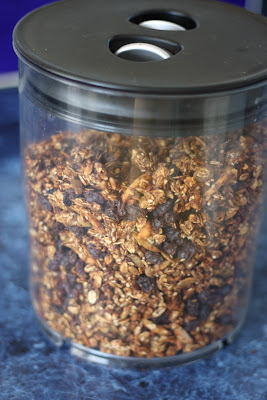
I popped my kiwicha and substituted that for the puffed millet in the granola and all was well.  I also snuck in a little buckwheat crispies and changed the fruit called for in the recipe.  I used dehydrated bananas, apples and cherries.  The granola came out great and tasty, but it has a bit too much sugar for my liking.  I wasn’t raised on any sort of sugar cereals (grape nuts? anyone?) so I like my granola to be barely sweetened.  I’m going to stick to my personal recipe but add in the TVP and kiwicha pop, what great protein-rich additions to a granola.  Great recipe, Hannah!  It was easy and yummy and beautiful.

Popularity: 25% [?]

Summer Muffin Lovin’


Summertastic!

I’ve been enjoying trying all the different kinds of granola at the food co-op but today I wanted muffins!  Based on my tiny pantry selection I had the right ingredients to make VWAV’s corn blueberry muffins but I altered the recipe.  Instead of using soy yogurt I substituted about 1/2 of a banana (mashed) and used fresh strawberries instead of blueberries.  I omitted the lemon zest and added about 1/4 cup of chiffonade basil.


The most beautiful one

YUM!  They were delicious, puffed up and browned nicely and tasted amazing.  I think the banana gave it a nice color and subtle flavor.  I love strawberry and basil and have a bunch of basil seeds in the sprout process.  Hopefully I’ll have a porch full of basil soon enough because to me, basil equals summer.

Popularity: 21% [?]

Scratch Nacho Night

I first discovered the beauty and simplicity of making nachos in college.  A friend bought corn tortillas to make burritos but he wanted flour tortillas and was very disappointed.  Instead of throwing out the tortillas, I played around and cut them up and baked them in the oven with oil and salt and I had that moment of AHA! I am a genius!  I felt as if I had invented nachos and nothing would ever be the same again.


Getting crispy

Obviously, I did not invent nachos but used my intuition to make them, which was deeply satisfying.  My husband bought some corn tortillas last week for tacos but I am not a fan of store-bought corn tortillas for anything other than turning them into nachos.  I bought some flour tortillas so I could get my burrito on, but with the corn torts, I went all out.  I FRIED THEM.

An old saying goes, “Everything tastes better fried.”  While this may be true, I don’t really want to eat everything fried all the time. It’s not ideal for the body.  I prefer baking or sauteeing, but tonight I wanted that greasy fattiness and it would be a good use for the Teese Vegan Cheese I bought.


Look at it melt!

Making nachos is easy but borderline dangerous (hot oil).  I simply cut the torts to a desireable size, heat some canola oil in a skillet (about 1/4″ of oil is fine, or plug in your FryDaddy).  Once the oil is good and hot, place the torts in, making sure to give them a little space from each other.  If the oil isn’t hot enough, the nacho will not get browned and crunchy, it will get really greasy.  Fry, flip, fry other side.  Place on a paper towel (if you want to reduce the grease factor) and sprinkle some salt on top.  The end.


The microplane version

To make my double decker nachos, I spread the chips across a plate, added beans, cilantro, fresh chopped garlic, scallions and Teese.  The Teese needs seasoning so I added a little jalapeno flakes, garlic granules, black pepper and of course, salt.  I added a little nutritional yeast and kelp flakes because I am crazy and strange sometimes.  Then, layer two of nachos and continue with the toppings to your delight.  I baked the nacho dish in a preheated oven (at 375deg F) for about 10 minutes, then switched it to broil mode to crisp up the top.  I forgot to pack my grater when I moved here, so all i had was the microplane.  Teese does not like the microplane, but it makes for an interestingly crunchy topping and a gummed up grater.  My other batch I sliced really thin strips and they melted into each other without hesitation.

Eat and enjoy.  I surely did.

Popularity: 24% [?]

Teese me, go ahead and please me

While I was in Peru, all I read about on people’s food blogs was the magical teese.  And what a tease it was, because there is very little access to vegan cheese outside of Lima.  Luckily, the local dairy cheese was NOT to our liking (unsalted chewy curds), so I was able to banish my addiction to cheese and ice cream while in Peru.

I was excited to find Teese when visiting FoodFight and although the price tag is hefty ($7.50/lb), it’s cheaper than fancy dairy cheese and we thought we’d give it a try.  It’s packaged like a sausage in a red wrapper but slices like fresh mozzarella and has a similar taste and texture to it.  It’s unsalted, and the water content was higher than I thought it would be.


Looks and tastes better than any other faux

I ate it in sandwiches with avocado (and salt!) and tomatoes.  I made a pizza to test the meltability and it did indeed melt.  If I wanted to brown it I had to broil it because baking it longer just seemed to dry out the teese (though it’s not bad crunchy…i will have to make mozz sticks next).  As pizza cheese, it’s perfect.  It’s not super stringy, but it stays together and provides a good mouthfeel.  As nacho cheese, it’s awesome.  I found that after adding the teese to whatever, I needed to salt and spice it to my taste (garlic, black pepper) because alone, it’s a little bland.  But I think it was meant to be like that.

Popularity: 21% [?]